Culture Ripple Effect

9933611F-ACAB-4F48-B432-015748CDEB0B

Leadership Tip of the week #101

adapted from HBR

By the age of six months, a baby begins to understand that his actions can affect his environment.

It’s amazing how as adults we quickly unlearn this.

As business leaders when we talk about shaping or changing company culture we sometimes forget to own the fact that we are the culture. Culture is not something that is laid down in a strategy document, or changed in the blink of an eye at an offsite event designed to rally the troops. Culture is how we act every day. It’s impacted by how we as individuals choose to behave and evidenced in the ripple effect that our actions catalyse.

When we seek change we often start by looking to see what we can change in others, forgetting that the ripples begin right where we are.

We must walk the walk and Talk the talk

Don’t Say “Change Is Hard” When You’re Asking People to Change

change

Leadership Tip of the Week #100

Adapted from HBR

When a change initiative hits a roadblock, leaders often remind people that “change is hard.”  But that old saw can become a self-fulfilling prophecy.

Momentary setbacks or delays can be viewed as the dead canary in the coal mine, and suddenly, employees disengage en mass.

Instead, try flipping the script. In a University of Chicago study, researchers were able to change participants’ mindsets by reminding them that most people improve with a little bit of effort.

The results?

Study participants were quicker to identify the upsides of change than the downsides.

Instead of accepting that initiatives rarely succeed, remind yourself and your team that you’ve all been learning new skills and adapting to new environments for your entire lives.

And every time you feel the impulse to say “Change is hard,” make a different claim, one that is every bit as accurate: Adaptation is the rule of human existence, not the exception.

Adapted from “Stop Using the Excuse ‘Organizational Change Is Hard,’” by Nick Tasler

Seven new realities of retail world

data-driven-marketing-4Consumers have fundamentally changed how they shop and how they buy. This shift has forced retailers to adapt to a new paradigm. Here are the seven realities of the new retail world

  1. A proliferation of new technologies has created substantial new opportunities to understand and serve customers, which means organisations must put forth the effort to integrate new technology into regular processes and procedures. Don’t start with technologies but start with people & processes.
  2. Removal of the Silos of  data and departments must be broken down to enable centralized data.
  3. Retailers must build complete, 360-degree portraits of customers to recognize them as individuals and understand their buying behaviors. Consumer personas are key to relevant and personalized experiences for customers who represent high-value potential for pro tability.
  4. Brands must reach across all channels and devices to provide meaningful experiences based on each consumer’s demonstrated preferences.
  5. The Customer Shopping Experiences across physical and digital channels should be seamless for consumers, while digital and physical measurement and attribution should be seamless for retailers.
  6. Consumers now expect personalised and relevant content that retailers can and must deliver, using data-based insights, to drive the best customer experience.
  7. All data must be handled in a transparent and ethical manner, with retailers accountable for ensuring it is used in ways that bene t consumers and protects them from harm.

Become the Future: know your customer

customer 5

BECOME THE FUTURE — KNOW YOUR CUSTOMER

With every new opportunity to engage and serve we are also provided an opportunity to learn. Smart retailers will use all of this to drive singularly and powerfully toward one ultimate goal…

Creating profound, data-informed, connections with your consumer.

We must never lose sight of the big picture to connect with and enrich the lives of each consumer as a unique and recognised individual. In the new world of retail, the future is a seamless and meaningful connection … and the future is here.

As we’ve seen, both from research and in execution, using integrated technology to understand, reach and provide value to your consumer is a strategy that works. But becoming exceptional, when it comes to ethical data gathering and deployment, isn’t just a good idea, it is the fundamental route to survival for modern retailers.

In spite of the state of urgency created by the increasing demands of consumers, many retailers are still behind the curve on both industry adoption and meeting customer expectations.

From seamlessly blended digital and offline worlds to introducing products and ideas that users don’t even know they want yet, today’s leading retailers are those who are setting trends — not merely keeping up with them.

As we look toward the horizon, we will find the brands that embody progress and thrive on the bleeding edge of technology will become the aspirational beacons in their space. The ability to cultivate breakthrough campaigns and captivate both your customers and your competitors’ customers is within your reach.

New Leaders: Bring people with you

great leaders business

New Leaders: Bring People with you…

Leadership tip of the week #99

adapted from HBR

When you start a leadership role, there’s pressure to prove yourself by getting off to a quick start and delivering early wins. But if people sense that you’re making a change without thinking it through — or getting their input — you’re unlikely to be successful.

That’s why you need to slow down, especially in your interactions. When talking with new colleagues, repeat what you hear, both to confirm your understanding and to demonstrate that you’re listening.

Ask the group reflective questions such as, “What just happened here?” and “What could we learn from that?”

These questions force a pause, preventing a discussion from rushing to a decision.

And don’t be afraid to use silence.

Pausing before you speak gives you a chance to weigh alternatives and decide on the best way to respond. It also pushes others to wonder what’s going through your mind, which may cause them to think more creatively.

Adapted from “Why New Leaders Should Be Wary of Quick Wins,” by Dan Ciampa

5 tips for driving (digital) success

5 fingersHere are 5 simple tips will help drive success in your organization and make you a (digital) hero:

1. Identify and understand the problems
This is so trivial but yet incredible important and frequently ignored. Companies, governments and other organizations try to solve problems without understanding them. The first step of solving any challenge, with our without technology, is to identify and understand the problem(s). I use plural because we often jump on the first problem when there are several. There’s a myriad of great tools to identify problems including the 5 Whys, Customer Journey mapping, Customer Research, and more.

2. Be inspired and challenged by great people
The honest truth is that most people are comfortable with what they have and know. The unknown and change is frightening. But to survive in the current competitive, fast-moving world we need to challenge ourselves to consider other points of view, think differently, and to change fundamentals.

These are a few ways you can challenge yourself:

  • Follow people on Twitter and LinkedIn such as Tom Goodwin, Martin Lindstrom and Benedict Evans
  • Meet and hire partners that will challenge you (and don’t always agree)
  • Talk to the competition’s customers

3. Always involve unbiased customers
Another basic mistake too many organizations make is solving problems without involving the people that are intended to use it. For example launching a website without testing the concept, content and final design on the intended target audience or deploying an expense management tool without including employees in the evaluation and implementation process.

Lack of time or cost are common excuses, but how much time and money do you lose when a website or software doesn’t achieve its goals?

Always involve end users at every step of the way. Remember that colleagues or the boss are usually not representative of the end users.

4. Define clear success factors, measure and follow-up
How do we know if we’ve achieved success if we didn’t define it in the first place? Many organizations have too generic or end-goal-centric metrics. The most common measures of success are revenue growth and cost savings. The challenge with these is that it’s usually not possible to measure success until e.g. 3-6 months after the project has been completed.

A better alternative is to include success factors that can be measured throughout the project. For example user task completion rate, satisfaction and sticking to the MVP timeline.

5. Understand why Culture eats Strategy for breakfast
Want to change the business or organization? Think that a new app, knowledge sharing system or HR website will achieve radical change? It won’t unless people want change. Ensure that every initiative to change has a plan to get buy-in from the organization including the grass roots. No. 3 above will help, but is not enough.

Use these 5 tips in whatever you do and I can promise you a greater chance of success. Furthermore there’s a pretty good chance that the organization will consider YOU a digital hero.

Amazon-Go leading the way

50823D32-9F8E-4366-911C-08E7E8142309

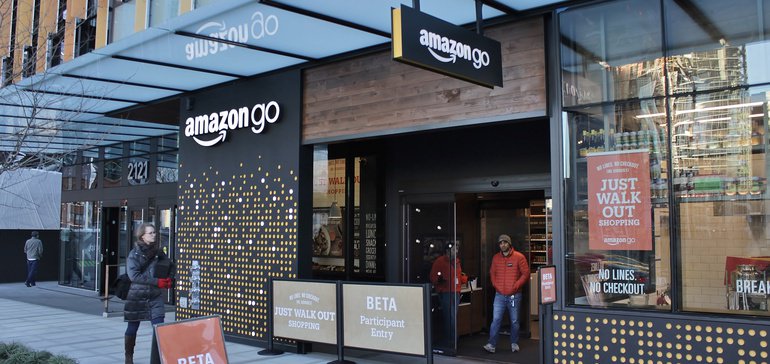
Amazon opened a fourth Amazon-Go cashier less convenience store in Chicago, the first location outside Seattle. The new store is at 113S Franklin St in Chicago’s Loop, one block from one of the City’s elevated train routes and within a few blocks of Union Station. Good C-Store location dense with Office workers and on a commenter path.

Amazon-Go using camera technology, scanners and Machine learning algorithms to improve the customer journey.  They may be ahead in technology but they still have a long way to go understanding Food Retailing.

Read here about the first store AMAZON GO-GO

Amazon isn’t the only one chasing a cashier less vision, Frictionless shopping is the goal of many retailers and start-ups.  Companies like Standard Cognition and Zippin have opened their own pilot stores so other retailers can use the technology.

Standard Market based in SanFrancisco is a concept store that users overhead cameras but no sensors to correctly matches items to the right shopper, detects when a shopper returns an item to the shelf or puts it in a bag or a pocket. (View a video HERE) Customers download the STandard Checkout App to shop and checkout. No scanning required for a frictionless experience.  View more detailed story HERE,

Zippin are a startup based in BAy Area of SanFrancisco and have a Beta-Concept store where they are learning fast  READ more HERE

MobyMart in Shanghai is learning fast  ( read story HERE)

and in UK Tesco and Sainsbury’s are trialing stores where customers scan the products themselves and then have a simpler checkout on a phone.

Making it as easy and frictionless as possible is the battleground of retail in the next few years and using data and digital to deliver a Better, Simpler, Cheaper Shopping Experience is the ExamQuestion for many retailers at the moment .


Standard Market – Frictionless Store

D032A51E-3D85-45A3-B303-75CFBFCC4A42

Standard Market based in SanFrancisco is a concept store that opened on 7th September located at 1071 Market Street, that allows customers to shop & pay without scanning or stopping to checkout. The Proof-of-concept store uses overhead cameras but no sensors to correctly matches items to the right shopper, detects when a shopper returns an item to the shelf or puts it in a bag or a pocket.

Customers download the Standard Checkout App to shop and checkout. No scanning required for a frictionless experience.

CHECKOUT A VIDEO DEMO BY CLICKING

This concept is potentially more scalable in Europe as it has higher levels of privacy with no Biometric information collected from customers including facial recognition, with lightweight installation process with overhead cameras and no sensors.

This is a great example of making the customer experience Better, Simple, Cheaper, with a frictionless experience for customers, simpler stores to run, and lower running costs ongoing. The opportunities around Anonomised shopper analytics in the store are also enormous, allowing continuous improvements.

7 steps Data-Driven Customer Growth.

seven steps

Accelerating customer growth to drive commercial success through data is challenging and requires commitment and alignment from around all the organisation to be successful, but there are 7 steps that make the journey more successful

  1. Identify the commercial & customer Goals in next 18m-36m
  2. Build a clear vision of a radically different data-driven customer experience, working across digital & bricks & mortar and align across the organisation.
  3. Remove Silos of data use creating a single version of the truth, with a data strategy linked to business goals e.g. Unified View of customer data, GDPR ready and tools developed to meet commercial goals.
  4. Breakdown the institutional fear of data & digital at all levels through training & doing: it’s a tool that anyone can use to do what you have been doing better
  5. Use Data Analytics to Map & Prioritise customer journeys & personalised experiences across human & digital touchpoints and align organisation capability to deliver for customer.
  6. Identify & Build the capabilities (Process, Tools People) that will be required to transform process design from efficiency focused (cheaper) to customer focused (better simpler cheaper) , specifically putting in place an analytics capability to enable data-driven, personalised journeys
  7. Foster stronger bonds between technical and different business people. This is a two-way process to ensure the technical teams understand the commercial imperatives, and customer solutions you would like to build, and the business teams learn to trust the expertise of technical IT teams. It will also allow you to improve data quality through showing the business impact.

Using Data & Advanced Customer Analytics  to put the customer at the heart of an organisation is a transformation that future looking organisations need to start implementing now.

Transformation to ensure data is part of the DNA of an organisation takes time and a holistic approach.

Don’t let one person dominate

people

Leadership Tip of week #98

adapted from HBR

You’ve probably led one of those meetings where someone talks, and talks, and talks — and no one else can get a word in edgewise.

It’s annoying, and potentially damaging to team morale.

Of course, you can’t always expect that everyone will contribute, but there are ways you can encourage broader participation.

When you open the meeting, let the group know that you want everyone to speak up. I

f someone is speaking too often during the meeting, ask them to hold back: “Andre, let me get some others into this conversation, and then I’ll come back to you, OK?”

Whenever someone is interrupted, double back and ask them to finish what they were saying. And if you’re the person interrupted, speak up: “Marie, I wasn’t quite finished. I’d like to complete my comment, and then I’d love to hear your thoughts.”

Adapted from “5 Common Complaints About Meetings and What to Do About Them,” by Paul Axtell

Physical to Digital – Phygital

kroger alibabab

How Kroger is driving Physical into Digital

Kroger is accelerating it’s Data and Digital capability fast , after buying out the JV with dunnhumby a few years ago, it’s announced two new strategic partnerships with Ocado and Alibaba

Two Partnerships

Kroger, which was founded in 1883 in Cincinnati, Ohio, is the United States’s largest supermarket chain, and in fact is one of the largest such chains in the world. With stores in 34 states, Kroger is a household name that for many typifies traditional brick & mortar stores. This week they announced a partnership with Chinese internet giant Alibaba, specifically to open an online storefront on Alibaba’s platform for international brands, Tmall Global. This first move into overseas sales is part of grocer’s online retail push. This sits alongside a recently announced plan with Ocado, to launch Kroger Ship an online food delivery service picked from automated warehouses.

Organic goods, dietary supplements, and other private-label products are expected to be included in the initial product offering.

Competitive Landscape And Why This Is Big

Kroger’s move comes as its traditional competitors aggressively cross into the digital space, while “digital” companies barge into what used to be Kroger’s exclusive territory.

Walmart, for its part, recently acquired a majority stake in Indian e-commerce giant Flipkart Group. It has been pursuing a strategy of leveraging their physical store base to drive them forward in the ecommerce landscape. What’s more, Walmart owns a 12% stake in JD.com Inc., Alibaba’s largest rival in China.

Amazon has been doing the opposite, particularly with their Whole Foods purchase, as they seek to expand their physical footprint while taking advantage of their digital strength.

Alibaba already owns 2 of China’s most popular e-commerce websites and is staving off competition from the aforementioned JD.com. They have also been active in signing on other US brands, such as Macy’s, Costco and Starbucks.

Digital For The Win

Digital is the way forward for even the most traditional brands. While perhaps a bit late to the party, the Kroger-Alibaba deal shows that companies not harnessing the power of ecommerce effectively have to have a smart strategy to catch up – and succeed – in the new era of ecommerce. This could be through acquisitions, mergers, or allying with the right digital partner. the proposed Asda / Sainsbury’s Merger is another example of retailers merging to compete vs digital competitors ( in this case amazon in UK)

When it comes to that right partner, companies both large and small are seeing the need for a holistic picture of their own operations, as well as the industry at large. Today, successful companies are leveraging data to spot future trends and markets, as well as to fine-tune minute details such as ranges, pricing, availability.

5 ways hard-headed leaders promote innovation

retail leaders

I have known many CEOs and CMOs over my career. The best ones created innovative transformational cultures. Many tried. Some failed to comprehend the definition of the word itself; others lacked the vital leadership traits to inspire creativity and implement great ideas. Those who were adept at driving innovation and sustaining it over the long haul had one thing in common: they were hard-headed.

Their tough-mindedness came from an unshakable belief that innovation is critical to corporate survival, and that without powerful and constant change, innovation would be elusive. These trailblazers were innovative leaders, but surprisingly some of them weren’t creative, themselves. That didn’t matter because they were good a recognizing great ideas and welcoming change. No change, no innovation.

So, how do unshakable leaders create change and how to they sustain the innovation outcome?

  1. They unsettle the organization. There’s a host of companies that get things done, control performance, spot problems and deliver their budgets. But the structures, the processes and the people that keep things ticking along can snuff good ideas and block movement through the system. Innovative leaders appreciate that there is a difference between what’s needed to run a business and what’s needed to foster creativity. This ethic prevents excessive layering from killing ideas before they reach the top.
  2. They’re hardheaded about strategy.  Leaders who embrace innovation have a pretty clear idea of the kind of competitive edge they’re seeking. They’ve thought hard about what’s practical and what’s not. So the approach is not wishy-washy, but focused and driven. When this methodology brings results, employees become disciples of the strategy and the culture that facilitates execution.
  3. They make innovation a priority in the “walk” as well as the “talk.” When executive teams demonstrate innovative thinking and practices, the rest of the organization is clear on direction. This facilitates coherent cross-functional teamwork and an innovative modus operandi that encourages diverse viewpoints.
  4. They take note of what’s already going on with a view to balancing creative thinking with the discipline of assessing solutions and their implementation. The best backdrop for spurring innovation is knowledge – knowing the business cold. Good ideas often flow from the process of looking at customers, competitors, and the business as a whole.
  5. They appreciate that not many ideas work the first time, so they’re prepared to praise failure, move on, or try again until the company gets it right. From there, innovative leaders marshal resources behind a few winners and then execute like the SKY Cycle team

Innovative leaders are a special breed. They aren’t as interested in “minding the store” as they are about “opening new stores.” Nor are they shy to admit to controlling strategic direction, influencing the culture, and monitoring the process and practice that unleashes business’s most elusive success factor.

retail leaders 2

anger management

Angry upset boy, little man

Leadership Tip of the Week #97

adapted from HBR

Only Express Emotions During a Conflict If They’ll Help You Resolve It

When a disagreement with a colleague gets heated, it’s normal to feel all sorts of emotions: disappointment, anger, or frustration, for example.

But should you express what you’re feeling?

It depends. If you’re experiencing what psychologists call a hot emotion — one that comes with an urgent sense of entitlement or even revenge (“I have to tell him exactly how I feel!”), it’s better to find a way to calm down first.

If the emotion is cold, meaning you can control it and use it to help the situation (“I want to tell him how I feel so that he’ll understand my perspective”), then it’s probably OK to express it.

But don’t just name the emotion; explain what’s causing it. Telling someone you’re angry is less helpful than sharing that you’re disappointed they didn’t follow through on their commitment to you.

Adapted from “Should You Share Your Feelings During a Work Conflict?,” by Susan David

5 ways to compete with Amazon

7D9FE3EA-A4CB-41A1-80DB-11BB7B801812

 5  ways to compete with Amazon

One of the biggest challenges that face retailers at the moment is how to compete with the jugganaut that is amazon. Powered by the profit driver in Amazon Web Services and more recently Amazon Advertising Services the retail industry fears the arrival. But there are ways of defending by attacking

Strategy #1: Own the pre- and post-transaction experience
Amazon are very focused on making the transaction as easy as possible at low cost, but we still have to assemble solutions on our own. If an organisation offers a ready-made solution that saves us time and effort (at a price we can live with), we’re grateful.

  1. Meal delivery companies, for example, have leveraged this basic insight to create a new category. Cooking a meal is time consuming: go to the supermarket, fight through the crowds order to find a few ingredients, wait in a long line, lug your bags home, put everything away, measure and chop the ingredients, and assemble the meal.Meal delivery companies like Gousto, HelloFresh, and simply cook eliminate all of these chores but the last one by shipping pre-made meals that require very little prep. (Amazon launched their own meal kit delivery service in July in order to catch up after falling behind for five years.)
  2. Furniture  or Clothing : Virtual Reality is allowing you to select and choose furniture or clothing that fits your room or you.Once you’ve selected what you want to buy, sometimes extra effort is needed to actually assemble, install, learn how to use it, customize it, and then repair it once it breaks.
  3. Electrical retailers: DixonsCarphone Warehouse are competing vs amazon in electrical by offered get technical support pre and post purchase. Installing Fridge freezers, Kitchen ranges / recycling fridges.
  4. Garden Retailers offering Garden Services
  5. Mothercare offering to come and assemble the cot or bed for you rather than you have to put things all together.
  6. Laura Ashley assembling beds.

Strategy #2: Turn your services into a platform
The fastest-growing companies in history, such as Google, Facebook, Uber, Airbnb, Amazon, and Netflix, are all platforms. The platform business model captures the most profit, builds a moat that is hard for competitors to cross, and scales quickly once it reaches critical mass. While building up a global workforce of employees to offer support services may take massive amounts of time and capital, a platform can get there in a fraction of the time. And, if you don’t do it in your niche, it’s likely that Amazon will — if it hasn’t already.
Amazon Services uses a platform model to deliver hundreds of services at scale including services with and for the home, automotive, electronics, yard and outdoor, assembly, health and wellness, lessons and classes, and pet services. It even has an Uber-like service, Amazon Flex, which has drivers in 30 cities who deliver Amazon products.

You can build a platform by focusing on your niche , playing to your strengths, particularly your unique understanding of your customer, in order to more effectively recruit, vet, train, and manage a network of service professionals and help them solve the specific problems that customers in your niche face. The most successful platforms in the world aren’t ones that offer every service under the sun. They are ones that are the most focused.

  • Uber is a platform that has focused on logistics and transport
  • Netflix is not trying to meet all entertainment needs, but focused on emotional connection

Netflix founder Reed Hastings: “We’re not trying to meet all needs. So, Amazon’s business strategy is super broad. Meet all needs. I mean, the stuff that will be in Prime in five or ten years will be amazing, right? And so we can’t try to be that — we’ll never be as good as them at what they’re trying to be. What we can be is the emotional connection brand, like HBO. So, think of it as they’re trying to be Walmart, we’re trying to be Starbucks. So, super focused on one thing that people are very passionate about.”

Strategy #3: Reduce every point of friction in your customer’s journey until you hit a ‘wow tipping point’
To reduce the friction at every step of your customer’s user journey, leverage your own customer data to uncover friction points and relentlessly remove them. Start by removing glaring problems. Then keep going until you reach the ‘Wow!’ tipping point
A hallmark of many of today’s most successful companies, is that they don’t stop improving their product once it’s good enough. They identify every interaction their brand has with a customer and aim to make it a ‘Wow!’ experience. It’s not just tech firms; retailers are taking note as well.

Strategy #4: Create a must-have brand and then use it as leverage
One of the biggest threats to Amazon is the power of brand. A truly powerful, must-have brand like Apple or Disney doesn’t need Amazon to succeed. They have built a direct relationship with the consumer. As a result, Amazon has lost tens of billions of dollars in potential revenue because people buy Apple products on Apple.com or in the Apple STore. Furthermore, Amazon’s whole business model is antithetical to people’s innate desire to display their personality and status through what they purchase. There is always going to be a segment of people who value self expression over low prices and convenience. The luxury category is one of Amazon’s Achilles’ heels.
Amazon is confronting the ‘brand’ threat in two ways.

  1.  First, amazon has shown that it’s not afraid to build or acquire its own brands (19 in total). Amazon also leverages its data on which products sell best in each category to launch its own generic brand, Amazon Basics, which now has over 3,000 products. In each category these products appear in, they are featured.
  2. commodifying brands by forced discounting, using its direct relationship with customers and audio purchasing to push competing commodity brands. With Amazon Alexa, customers can say, “Buy toothpaste,” and Amazon will send its recommended toothpaste rather than the toothpaste with the best brand, for example.

Make no mistake, Amazon is trying to destroy the value of branding overall and learn from your customers in order to compete with your most profitable products. Bezos’ famous saying, “your margin is my opportunity,” is particularly relevant here. Branding creates a perception that facilitates charging a higher price. Bezos is attacking that pillar of higher prices.
By having a must-have or a luxury product, you give yourself choices on how to leverage your brand:

  1. using an embargo period Netflix keeps its original content exclusive to Netflix for a certain number of days and then sells it on iTunes and other platforms. The other platforms are not only sources of cash, they are also marketing.
  2. allowing just some products to be sold on Amazon (sell some brands on Amazon and others only on your own site),
  3. not selling on Amazon at all (Birkenstock, for example, prohibits its sellers from selling on Amazon. Sales tripled to $800 million last year),
  4. partnering exclusively with one brand. (Martha Stewart has a multi-year exclusive agreement with Macy’s).

Strategy #5: Defining the problem & Extreme Experimentation

Amazon really understands the problem that they are trying to solve. and works hard to clarity the brief for any new innovation, making it crystal clear what the customer problem is they are trying to solve and then how they will develop a proposition to solve that problem .

This, more than any other strategy, is why Amazon is so successful: Amazon is not a traditional business. If you think it is you have already lost. You are competing against an economy.

Part of what makes the Economy Pyramid Model so successful is the sheer quantity of experimentation. Amazon’s culture of listening to customers , defining the problem & experimentation is so deeply ingrained that Bezos has repeatedly gone on record saying that Amazon’s success is directly correlated with the number of experiments it performs.

Amazon isn’t just experimenting internally with new platforms like Alexa, Kindle, Flex, Marketplaces, and dozens of others. Each of those platforms then empowers an economy of producers to create millions of experiments. In so doing, Amazon passes the cost of experimentation on to producers, receives income for each experiment, and then doubles down on the blockbusters by creating their own competing brand. It’s a brutally effective strategy. Amazon aggregates producer experiment data to launch its own competing products.
In a world that is rapidly changing, the companies that succeed will be those who increase their rate of experimentation faster than the environment changes. And Amazon is a core part of that environment.

If you need help in defining the problem and creating experiments contact me.


Zara’s Click & Collect Robots

zara C&C

As much as a third of Zara’s online sales are picked up in one of their stores. This in turn has led to a problem for the retailer, with long queues of disgruntled customers at the Click & Collect desk.

In an attempt to make the customer experience better-simpler-cheaper, Zara has developed a robotic service that involves fetching ordered items from the back of the store and bringing them to a drop box where the customer can collect them. Customers now only need to enter a collection code when they arrive in a store which activates this process.

Better-Simple-cheaper example of using Customer Data & Robotics to improve the Customer Experience

Look after yourself when things get busy

harley-havidson-dog

Practice Self-Compassion During a Work Crunch

Leadership Tip of the week #96

adapted from HBR

When work is intense, it’s easy to beat yourself up for letting things slip at the office or at home.

But doing so can make the stress worse.

Have self-compassion instead: Accept that you’re in an acute period of work stress and notice — don’t suppress or deny — your emotions.

Assigning a word to what you’re feeling, such as “pressure,” “guilt,” or “worry,” can activate the prefrontal cortex, which is responsible for executive functioning skills.

  1. Assess your to-do list by deciding what you need to get done each day and what can wait.
  2. Don’t be afraid to ask for help, whether it’s renegotiating a deadline with a colleague or getting family members to pitch in at home.

Having compassion for yourself will help you increase your focus and get through the crunch with greater ease and peace.

Adapted from “5 Ways to Focus Your Energy During a Work Crunch,” by Amy Jen Su

Two Questions to ask to be a role model of productive conflict

C7168324-02E8-4C7B-8BC7-820EED675E17

Leadership Tip of the week #95

adapted from HBR

Conflict is a normal, healthy part of working with other people.

And yet many of us avoid it at all costs — often because it feels personal.

To get more comfortable with disagreements, and to reap the benefits of productive conflict, let go of the idea that it’s all about you.

If you model that you’re comfortable with productive conflict, you’ll show your team that it’s OK to disagree, encouraging people to raise their ideas.

To move a work conflict away from the personal, think about the bigger picture and the business’s needs. Disagreements often arise over objectives and processes, for example.

When you and a colleague have different views about something, ask yourself two questions

1. Why is this difference of opinion an important debate to have?

2. How will it help the organization or the project you’re working on?

The more you can keep a conflict focused on the business, the better chance you have of resolving it in a way that benefits everyone.

Adapted from “Why We Should Be Disagreeing More at Work,” by Amy Gallo

Solve Complex Problems by Expanding your Thinking

people16

Leadership Tip of the Week #94

Adapted from HBR

Too many leaders approach complex problems with either-or thinking: The answer is right or wrong, good or bad, win or lose.

To cultivate a nuanced perspective, challenge your understanding of the problem. Ask yourself, “What am I not seeing here?” and “What else might be true?” Don’t seek out answers that just confirm what you already know.

It’s also helpful to tackle this kind of challenge first thing in the morning, when your mind is fresh. Spend at least an hour on it without interruption. The dedicated time ensures that you give a complex issue the attention it needs — attention that might otherwise be consumed by less intellectually demanding tasks.

And as you work, pay attention to how you’re feeling. Embracing complexity is an emotional challenge in addition to a cognitive one. You’ll need to manage tough emotions like fear and anger and get yourself out of flight-or-fight mode so that you can think more expansively.

Adapted from “What It Takes to Think Deeply About Complex Problems,” by Tony Schwartz

Alexa I’ll have a skinny decaf latte

starbucks-korea (1)

Starbucks have always been leaders in mobile technology to improve the customer experience, with leadership in mobile order & pay technology.

In an initiative designed to simplify ordering even more consumers in Korea can now remotely voice activate a Starbucks order using Samsung’s digital assistant Bixby. They can also pay for it at the same time in advance of picking it up . Starbucks led in South Korea ( a digitally leading culture) to be the first to leverage the technology to improve the customer experience

Use If-Then Thinking to Change Your Behaviour

85130198-31E7-4529-8249-065109F4AE45

Leadership Tip of the week #93

adapted from HBR

We all have habits and behaviors we wish we could change.

But just being aware of a bad habit isn’t enough.

To truly fix it, start by considering your goal (say, “I want my team to know that I trust them”) and the obstacles you expect to face along the way (“I struggle to delegate”).

Next, frame what you will do about the obstacles as if-then statements.

To address the delegation obstacle, for example, you could tell yourself: “If I start to feel uncomfortable about not completing the work myself, then I’ll ask for updates on it in our next team meeting.”

Eventually the link between the cue (the “if” part of the statement) and the action (the “then”) will become strong enough to help you change how you react.

By using if-then statements, you can think through what will get in your way and make a plan to overcome it.

Adapted from “Two Techniques for Helping Employees Change Ingrained Habits,” by Joel Constable

Frictionless C-Stores

Creating a seamless frictionless shopping experience is the goal of physical/ digital retail.

Amazon-Go has made the headlines ,Tesco have just announced the launch of a store with no checkouts,  and Sainsbury’s have a trial store in Clapham North but there are other examples around the world where retailers are learning fast:

The Moby Mart, based in Shanghai created by Wheelys, Hefei University of Technology and tech firm Himalafy, has been dubbed ‘the supermarket that comes to you’.

The Moby convenience store is a prototype C-Store that features no staff, no cash registers and runs on wheels, which means it can deliver orders or take itself off to a warehouse for restocking

To enter the C-Store customers download an app and register. They scan any item they wish to purchase or add it to a smart basket which tracks what they are buying. The customers card is automatically charged on leaving the store.

Moby uses advanced analytics and clever use of data and digital to create the new store

Forward-thinking Retailers will continue to use data and digital tech to create a friction-less customer experience that is better, simpler and cheaper for their customers in a relentless drive to meet their needs. The checkout / basket will be the biggest focus of development for retailers as it has one of the highest costs to serve, and the biggest opportunity to improve the customer experience.

Robots make stores Better Simpler Cheaper

Robotics driving acceleration in Better Simpler Cheaper

Walmart Bossanova Robot

Retailers are increasingly using Robotics to perform simple tasks and make the customer experience Better, Simpler, Cheaper for their customers

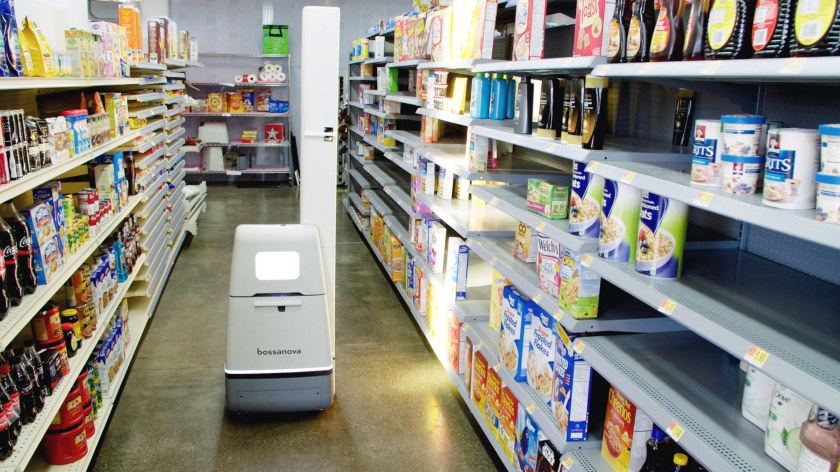
Walmart is using Robots from Bossanova in 50 of its USA stores to autonomously move around the aisles and, using a combination of image recognition and RFID to check inventory labels, enabling planogram compliance across the store. The robots can also read labels, detect if they are in the right position, as well as check they are showing the correct price. This is a bold move to remove tedious tasks for colleagues, replacing them to do more added value activity.

ocado warehouse

Ocado is continuing to invest in Robotics in its warehousing capability. The fleet of robots in its new  distribution site can now put together a 50 item order in 5 minutes, compared with the two hours that it previously took. The robotics have also increased the capacity fulfilling as many orders per hour as a warehouse three times the size, increase the range , reduce the waste levels to less than 1% vs industry average 4-5%.

These innovations mean that customers get a better service, it’s Simpler for colleagues and it’s Cheaper for the retailer which means they can make products cheaper for customers.

A Win-Win.

7 steps to data driven customer obsession

seven steps7 steps to data driven customer obsession

The battle for customers is not BAU, with data being “the New Oil” that can transform the customer experience through advanced customer analytics.  Creating a Customer Obsessed Organisation that puts the customer at the heart of the business and designing the human and digital customer experience are top priorities to win in the age of the Digital Customer.

The road to travel on to build advanced Customer analytics that transform the customer experience is challenging and requires commitment and alignment from around all the organisation to be successful

  1. Identify the commercial & customer Goals in next 18m-36m
  2. Build a clear vision of a radically different data-driven customer experience, working across digital & bricks & mortar and align across the organisation.
  3. Remove Silos of data use creating a single version of the truth, with a data strategy linked to business goals e.g. Unified View of customer data, GDPR ready and tools developed to meet commercial goals.
  4. Breakdown the institutional fear of data & digital at all levels through training & doing: it’s a tool that anyone can use to do what you have been doing better
  5. Use Data Analytics to Map & Prioritise customer journeys & personalised experiences across human & digital touchpoints and align organisation capability to deliver for customer.
  6. Identify & Build the capabilities (Process, Tools People) that will be required to transform process design from efficiency focused (cheaper) to customer focused (better simpler cheaper) , specifically putting in place an analytics capability to enable data-driven, personalised journeys
  7. Foster stronger bonds between technical and different business people. This is a two-way process to ensure the technical teams understand the commercial imperatives, and customer solutions you would like to build, and the business teams learn to trust the expertise of technical IT teams. It will also allow you to improve data quality through showing the business impact.

Using Data & Advanced Customer Analytics  to put the customer at the heart of an organisation is a transformation that future looking organisations need to start implementing now.


Don’t say change is hard when talking to colours

changeLeadership Tip of the Week #92

Adapted from HBR

When a change initiative hits a roadblock, leaders often remind people that “change is hard.” But that old saw can become a self-fulfilling prophecy.

Momentary setbacks or delays can be viewed as the dead canary in the coal mine, and suddenly, employees disengage en mass.

Instead, try flipping the script, and recognise that adaptation is a golden rule of human existence, not an exception and we have been doing it for Millions of years.  In a University of Chicago study, researchers were able to change participants’ mindsets by reminding them that most people improve with a little bit of effort.

The results?

Study participants were quicker to identify the upsides of change than the downsides.

Instead of accepting that initiatives rarely succeed, remind yourself and your team that you’ve all been learning new skills and adapting to new environments for your entire lives.

And every time you feel the impulse to say “Change is hard,” make a different claim, one that is every bit as accurate:

Adaptation is the rule of human existence, not the exception.”

Adapted from “Stop Using the Excuse ‘Organizational Change Is Hard,’” by Nick Tasler

Two Questions to Ask Colleagues

0FDF0B7F-3181-48E0-A9F0-A808F118099B

Leadership Tip of the Week #91

adapted from HBR

Understand How You’re Perceived at Work, Ask two questions: 

It’s not easy to understand how other people perceive us. Too often, we assume that our motivations and intentions are clear, when they’re really not. To learn how you’re perceived at work, follow this process.

1. Select five people who observe you regularly in important work situations — bosses, executives, direct reports, peers, or even former colleagues — and ask to meet with them individually.

2. Tell them what you’re hoping to learn, and ask two questions:

A. What is the general perception of me?

B. What could I do differently that would have the greatest impact on my success?

3. Be clear that you’ll keep confidential whatever they say and that you’re collecting feedback from a number of colleagues.

4. Look for themes and points that multiple people agree on.

If the perceptions of you are in line with what you intend, great. If not, it’s time to change your behaviors and begin to shift people’s perceptions of you.

Good Luck

Adapted from “How Are You Perceived at Work? Here’s an Exercise to Find Out,” by Kristi Hedges