Data Pulses to stimulate

Three ways to fix Mediocrity

Einstein-Mediocrity-Quote

When  Team’s Performance Is Mediocre, Fit It Quick

Leadership Tip of the week, adapted from HBR

What do you do when someone’s work is OK but not great? The toughest test of a manager isn’t dealing with poor performance — it’s addressing mediocrity. Don’t let lackluster performance fester.

  1. Start by showing how mediocrity negatively affects your team, the organization, and its customers. You could, for example, have middling employees listen in on calls with complaining customers so that they understand the negative effects of not doing their jobs well.
  2. It’s important to share accountability. Encourage your colleagues to immediately and respectfully confront one another when problems arise. There is no way for even the strongest supervisor to see and address every performance gap.
  3. Speak up when you see mediocrity in other parts of the organization. For example, if everyone knows that a corporate initiative isn’t working but no one is discussing it, your team will notice whether you have the integrity to point out the emperor’s lack of clothes.

High performance is a norm that needs to be defended regularly and vigilantly.

Adapted from “What to Do About Mediocrity on Your Team,” by Joseph Grenny

Data-driven Pop

Sprite Cherry LeBron

The Coca Cola Company is the world’s largest beverage company selling more than 500 brands of soft drink to customers in over 200 countries. It generates mountains of data – from production and distribution to sales and customer feedback, and the company relies of a solid data-driven strategy to inform business decisions at a strategic level.

In fact, Coca Cola was one of the first globally-recognized brands outside of the IT market to speak about Big Data, when in 2012 their chief big data officer, Esat Sezer, said “Social media, mobile applications, cloud computing and e-commerce are combining to give companies like Coca-Cola an unprecedented tool-set to change the way they approach IT. Behind all this, big data gives you the intelligence to cap it all off.”

Product development

Coca Cola is known to have ploughed extensive research and development resources into artificial intelligence (AI) to ensure it is squeezing every drop of insight it can from the data it collects.

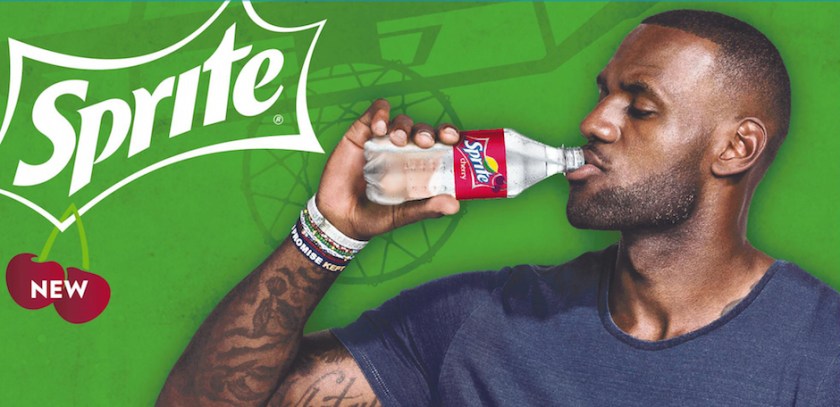
 Fruits of this research were unveiled earlier this year when it was announced that the decision to launch Cherry Sprite as a new flavor was based on monitoring data collected from the latest generation of self-service soft drinks fountains, which allow customers to mix their own drinks. As the machines allow customers to add their own choice from a range of flavor “shots” to their drinks while they are mixed, this meant they were able to pick the most popular combinations and launch it as a ready-made, canned drink.

Healthy options

As sales of sugary, fizzy drink products have declined in recent years Coca Cola has also hooked into data to help produce and market some of its healthier options, such as orange juice, which the company sells under a number of brands around the world (including Minute Maid and Simply Orange).

The company combines weather data, satellite images, information on crop yields, pricing factors and acidity and sweetness ratings, to ensure that orange crops are grown in an optimum way, and maintain a consistent taste.

The algorithm then finds the best combination of variables in order to match products to local consumer tastes in the 200-plus countries around the world where its products are sold.

Social data mining

With 105 million Facebook fans and 35 million Twitter followers, social media is another hugely important source of data for the company.

Coca Cola closely tracks how its products are represented across social media, mining this gives insight into who is consuming their drinks, where their customers are, and what situations prompt them to talk about their brand. The company has used AI-driven image recognition technology to spot when photographs of its products, or those of competitors, are uploaded to the internet, and uses algorithms to determine the best way to serve them advertisements. Ads targeted in this way have a four times greater chance of being clicked on than other methods of targeted advertising, the company has said.

Watch for signs of stress on your Team

stress

Watch for Signs of Stress on Your Team

Leadership Tip of the Week

adapted from HBR

As a manager, it’s your job to watch for signs of stress on your team so that you can intervene before someone disengages, gets sick, or needs to take a leave.

Keep an eye out for the warning signs:

  • Does someone on your team seem overly tired or constantly overwhelmed?
  • Have they been unable to control their emotions lately?

Of course, everyone has good and bad days, but most people can regulate their emotions in a way that’s appropriate for the workplace. Outbursts or high and low mood swings can be a sign of stress overload.

If you notice any of these signs, start a conversation with the person. You might ask a simple question, such as “Are you OK?” or “How are you doing?”

And if the person is open to talking, mention the signs you’ve observed and express your concern.

Adapted from “An Early Warning System for Your Team’s Stress Level,” by Thomas Hellwig et al.

Everyone Everywhere True North

customers 14.jpg

I learnt early in my career that Service organisations have millions of brand touch points delivered everyday by colleagues who interact with customers. Once you have defined the Customer Offer and Brand Story, aligning all the Brand touch points to give a consistent Brand Story is critical for success. This is the  essence of the “True North” turn around plan at Co-op Food. There are lots of ways to do this:

Tesco has implemented Yammer – an ‘enterprise social network’, allowing them to realise a vision of having ‘over half a million valued colleagues effortlessly connected and aligned:  Everyone, Everywhere’. To make this work, Tesco had to also change policies and processes: Tesco added in-store wifi and changed their policies to allow store staff to take their personal mobiles onto the shop floor.

Coop has changed the policy that allows colleagues to use their own mobile phones in the convenience shops , and they have uses several different tools ( WhatsApp, Slack ) to enable colleagues to communicate more clearly with each other. Posting pictures, chating and solving their own problems.

This has helped to create a sense of community between colleagues that extends across stores. Colleagues use the network to celebrate success, share learnings, ask questions and find answers. For example, bakers might share images of their morning display – and the service has even been used to share excess stock with nearby stores that are running low

Yammer has encouraged greater cooperation and a healthy sense of competition. Directors are also able to monitor conversations and can react quickly if required.

How to win in the age of the Digital Customer?

faces5

How to Win in the age of the Digital Customer

data pulse # 19

The Chief Customer Officer has a new agenda . Creating a Customer Obsessed Organisation and designing the human and digital customer experience are top priorities to win in the age of the Digital Customer .

This battle is not business-as-usual, for the following reasons:

  • Traditional loyalty structures are eroding, causing companies to have to work harder to retain customers or risk driving up churn.
  • Customers expect high levels of personalisation, forcing companies to design experiences as close to the individual level as possible.
  • Agile digital companies are seeking to disintermediate the relationship between both traditional digital and brick-and-mortar companies and their customers.
  • Companies must now differentiate on the experiences they deliver to customers.

Each of these forces creates challenges; more importantly, the additive impact of these forces mandates deep-rooted changes in a company’s strategy and operations.

To state the obvious, customers neither understand nor care about how hard it is to deliver consistent, quality and personalized experiences.

Taking stock, the CCO’s agenda now looks more and more like the CEO’s or COO’s agenda.

The agenda

The CCO’s agenda can be separated by a line of visibility: some pieces customers can see, and some they cannot.

Key initiatives such as strategic positioning, brand and loyalty programs are traditional CMO agenda items.

The new and most important item is designing consistent, high-quality, and personalised experiences across both human and digital touch points.

The need to differentiate on the basis of experience is really what drives the deep-rooted operational changes below the visibility line. In most cases, delivering differentiated experiences is not business-as-usual; it will require more severe structural and operational changes such that a company looks and operates differently than it does today. The CMO agenda now consists of:

  1. Making organisational changes to better align capabilities and ensure a seamless delivery of experiences across human and digital touch points.
  2. Transitioning process design from being efficiency-focused to customer-focused.
  3. Making hard changes in people and culture, including leadership, new roles, competencies and a customer-focused culture that fuels the business.
  4. Putting in place an analytics capability to enable data-driven, personalised journeys.
  5. Initiating or accelerating the business technology agenda to improve technologies that deliver customer value and drive growth.

Combined, these efforts tell us that companies, and CCOs specifically, need to think hard about making a fundamental shift in their operating model. To add to the complexity, changes to the operations across the company need to be sufficiently cohesive to ensure they don’t damage or create uneven customer experiences.

For better or worse, this is what is in front of many CCOs/ CMOs today — to lead the charge to understand the consumer mind set in the digital age and truly become a customer-obsessed organization.

This isn’t veneer or some clever tagline. It is the hard work to differentiate and win in the Age of the Digital Customer

Segmentation made simple

netflix programmes

Segmentation made simple 

data pulse #37

Delivering the most relevant, inspirational messaging and experiences through advanced segmentation and targeting is a key advanced use of data. Segmentation itself is relatively straight forward, we all do it all the time. The skill for CMO lies in bridging the technical teams and the business imperatives to develop segmentation that delivers on commercial objectives

Netflix is an organisation that uses data in three of the advanced states. Netflix micro-tagging of vast content archives allowed creation of nearly 77,000 film segments, rich data, views, searches , times, pauses and more is used to build behavioural profiles and predictive algorithms give uniquely targeted recommendations.

The segmentation techniques are not dissimilar to the segmentations that I’ve used at Tesco, Sainsbury’s and Asda . Both cluster users based on attributing product features to films / products and then clustering film watched/ products bought using analytics.

The difference is the Volume, Velocity and Veracity of data used.

Coop Food apply 7 segments to members annually,

Netflix create 77,000 segments on daily basis, continually refining which segment members are in so better able to predict your best next film.

More complex isn’t always better, as organisations need to WALK before they can RUN, and align people and processes before they build more complexity. Coop is now using customer segmentations and tools and processes for building ranges and promotional plans, and continually building and refining.

Customer focus, data-driven to deliver commercial imperatives.

Building more sophisticated segmentations will develop but add value if they are aligned to deliver commercial objectives, so creating strategic and operational capabilities


Grab a Breakfast at Greggs

greggs

It’s not something that you would usually associate with Greggs The Pasty Champion but they have now entered the Digital world and starting to create an omni-channel customer journey that has the potential to change the high street and take on Starbucks at their own game.

This week Greggs updated it’s new ‘Greggs Rewards’ mobile payment app designed to reward its customers for their loyalty whilst making shopping across its 1,700 shops more convenient, quicker and easier.

The rewards app is the first entirely digital loyalty scheme launched by a UK food-on-the go retailer that eliminates the need for customers to carry a separate loyalty card or their wallet when they shop.

By registering for a Greggs Rewards account via the app or online at http://www.greggs.co.uk, customers can top up their accounts with any amount from £5-£50 using their debit/credit card or with the added safety and simplicity of PayPal, allowing them to pay securely in-store with their smartphone.

Greggs Rewards will not only allow customers to pay swiftly for their purchases, but also reward them with exclusive treats and rewards built in to the app.

These offers include a free Greggs’ breakfast when opening an account with at least £20, hot drink incentives (e.g. buy 7 coffees get your next free), a birthday treat and a monthly prize draw for the chance to win an i-Pad when shopping using Greggs Rewards. Furthermore, PayPal is also giving the first 10,000 Greggs’ customers a free £5 bonus credit to spend when they sign up and register for auto-top up with PayPal.

Greggs Rewards has been developed using the Eagle Eye digital transaction network which enables retailers, in real time to connect with potential and existing customers, to deliver relevant offers, rewards and services that can be redeemed securely through any point of sale. The digital solution removes the need for paper vouchers or plastics cards, making for a seamless shopping experience that eliminates fraud.

Greggs have built a great machine with IT and payment partners the challenge exists whether they have also built the internal capability to learn how to follow the customer and add value in a segmented and targeted way.


7 Simple Steps to Data Heaven

data whowhatwhenwhy

Data pulse #43

The new European data Regulation GDPR will be coming into force soon, and many organisations still haven’t started to even be aware of the new law let along prepare for it’s arrival.

The GDPR is a real opportunity to build TRUST in the organisation , making it better for customers, simpler for colleagues and also save money! If you take a proactive approach and start to prepare soon, it could be a real opportunity rather than a Risk on the corporate Risk register.

Here are seven simple Steps to take:

  1. Map your data flows: so you understand where data exists in the organisation
  2. Map the customer Journey: does it align to the first point?
  3. Categorise your data :prioritise where you need to focus effort into priority 1/2/3
  4. Review your Partners Agree ownership and standards you expect.
  5. Evidence the standards you apply: use the DMA or ICO privacy seal
  6. Identify Resources required for Training
  7. Complete a GDPR audit: ICO will be able to help you understand where you now sit

Building awareness in the organisation of the facts as well as the simple steps that are needed to be taken will ensure that energy is focused on delivering the right outcome for customers and your organisation.


Keep Encouraging Colleagues to Learn

change reality

HBR Management Tip of the Week

The best way for organizations to drive the business forward is to make sure that employees are continually learning. Building a LEARNING culture is better than building a KNOWLEDGE culture, because you create an organisation that can continually adapt to the changing world.

What can managers do to encourage learning?

When you’re hiring, look for people who have demonstrated that they’re lifelong learners. Then look for services that provide up-to-date, relevant content on a wide variety of topics.

Don’t worry if your employees want to learn something that’s not directly related to their job.

By learning something new, no matter what it is, they’re practising the skill of learning, which is invaluable. Plus, you never know how learning an unrelated skill can help down the road. But do take an active role in partnering with your employees to figure out the skills they need to develop based on business goals.

And don’t forget to encourage and reward people who demonstrate quick adaptive learning.

Adapted from “To Stay Relevant, Your Company and Employees Must Keep Learning,” by Pat Wadors 

Three steps to Driving Customer Analytical Success

innovation

There are three simple steps to ensure Customer Analytics drive commercial success in an organisation

  1. Strive for excellence in customer analytics matters (vs merely good average).
  2. Establish a culture that values fact-based decision making and analytics
  3. Secure senior management involvement in customer analytics.
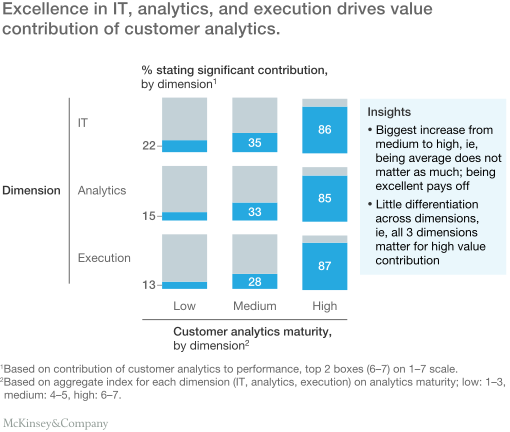
  1. Strive for excellence in customer analytics matters (as opposed to a merely good average). More than 85 percent of companies that report extensive use of customer analytics (in terms of IT, analytics, and its execution) claim their company achieves a significant value contribution from customer analytics. This compares with around 20 percent for low users of the function, and some 30 percent of moderate users—suggesting that companies start to reap substantial benefit from customer analytics only when they achieve excellence, i.e., when their function can be considered state of the art. Just moving from a low to a medium level of maturity will merely generate limited success

This has particularly important implications for managers and their decisions on what needs to be invested in their organisation’s customer analytics to be competitive in the future. They need to determine the performance gap between their current customer analytics and state-of-the-art customer analytics in their industry, and to ensure that their additional spending on customer analytics stands a fair chance of bridging this gap. Otherwise the additional spending will—despite the best of intentions—turn out to have been a sunk investment right from the outset (because it will not pay off eventually).

2. Establish a culture that values fact-based decision making and analytics.

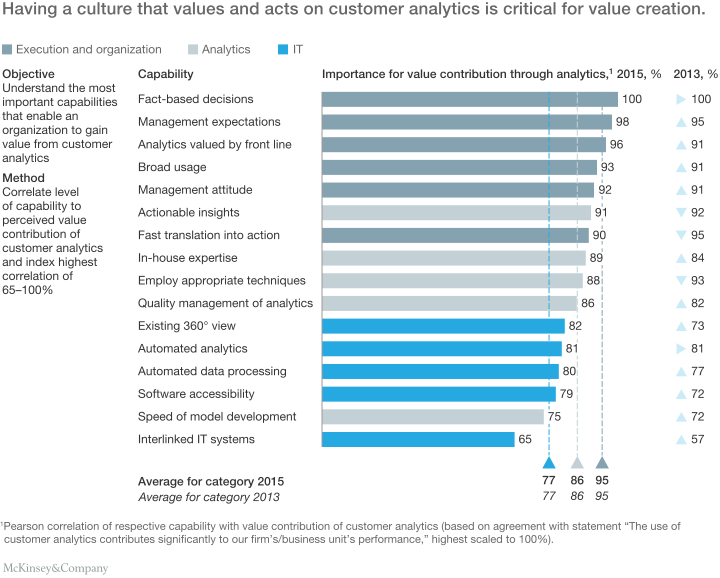
It’s vital that the culture that is not focused purely on IT and analytics topics, but approaches customer analytics holistically. Although investments in IT and skilled employees are important, these investments alone will not deliver value. Leadership that expects fact-based decisions and an organization that can quickly translate those decisions into action are qualities more likely to lead to success than companies focused exclusively on IT.

a) the execution and organizational aspects of customer analytics (such as a culture of fact-based decision making, analytics valued by the front line, management attitude and expectations) correlate most with the value contribution of customer analytics . This suggests that it is the culture and organizational setup that moves the needle even though IT and analytics expertise are obviously necessary to create value from customer analytics.

b) Having pragmatic and actionable foundations with the right cultural mind-set in place within the organization is more important than the perfect solution. Within execution and organization, for instance, fact-based decision making and management expectations are more important than the speed at which these insights are put into action. Within analytics, the focus is on delivering the right actionable insights, and less on the fast development of new models. Looking at IT, a similar pattern emerges: a pragmatic 360° data mart that builds the foundation for customer analytics is more important than the complete (automated) linkage of all IT systems.

A key success factor is therefore to examine customer analytics holistically, including IT, analytics, and execution/organizational setup, and to pragmatically improve on all dimensions.

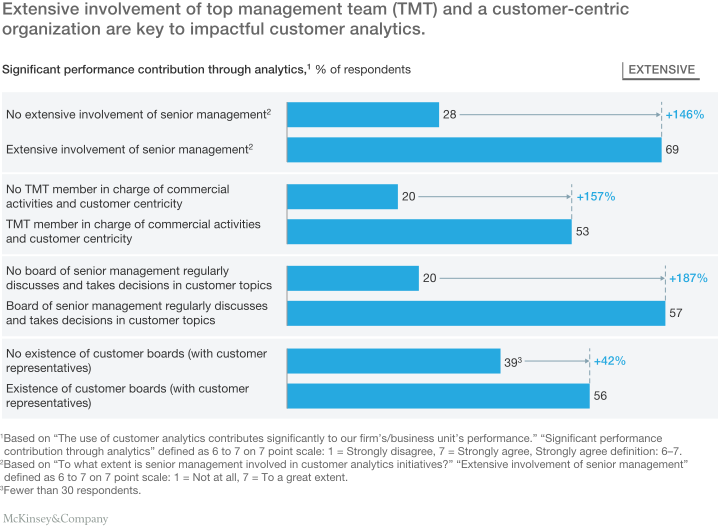
3 Secure senior management involvement in customer analytics. High-performing companies are led by data-savvy C-level executives who understand the importance of and involve themselves in customer analytics. Companies where senior management is not involved extensively, only 28 percent report a significant value contribution of customer analytics, versus 69 percent of companies with senior management involvement in customer analytics that say that customer analytics drives value

Specifically, looking at the level of management that should be involved, it becomes clear that what drives the value contribution is top management/board involvement. If the company has established a role within the top management team (TMT), such as via a chief commercial officer, more than half of the respondents (53 percent) stated that customer analytics contributes significantly to value creation. If only senior management is involved but not the TMT, this drops to just 29 percent, close to the value of no senior management involvement at all (20 percent).


In summary: three factors to drive Analytical Success:

  1. Strive for excellence in customer analytics matters (vs merely good average).
  2. Establish a culture that values fact-based decision making and analytics
  3. Secure senior management involvement in customer analytics.


Dunkin Donuts Data Perks

dunkin donuts coffee and donut

Dunkin Donuts are just beginning to establish themselves in UK but in USA are the largest coffee retailer, and have applied data driven analytics and technology effectively to improve the customer journey.

A coffee and a Donut is one of the most popular calls, and is the mainstay of this convenience foodservice retailer.

Dunkin Donuts recognised the key to convenience retailing lay in the palm of their customers hands and build a customer journey revolving around the smart phone. They created an app based journey where customers could pre-order, collect and pay for their Dunkin Donut. It started with a minimum credible product, simple sign-up and sign-in and has developed into one of the most recognised programmes in USA.

. They understood the customer journey not in part but fully and recognised they were a convenience foodservice retailer and making a coffee and a donut easy for customers would drive more customers to make more visits.

Dunkin Donuts wanted to reward loyal guests in a fast and convenient manner, and provide an overall superior customer experience. Very similar to the goals that Whole Foods had in mind when launching its own loyalty program.

Understanding the Commercial Goals: Dunkin Donuts used advanced analytics to understand the commercial imperatives, and what would best drive them. They recognised that there was a bigger upside from increasing visits and number of visits that slightly increasing the average basket. ( There are only so many coffees and donuts you can eat in one sitting , but it’s important to be the coffee house of choice when there is a choice of 2-3 on the street.

Design a Customer experience that delivers the commercial imperative: They were clearly focusing on driving additional visits from additional customers because they designed a DD Perks programme that rewarded frequency vs average basket.

The Points based reward Rewarded Frequency: Assuming people ordered a coffee and a donut they earned points which became a free coffee every 10-20 visits.  High value to the consumer and relatively low cost to Dunkin Donut.

They also made it easy and intuitive to sign up, and in addition to the basic points structure, Dunkin’ also included features to drive more sign-ups. Sign up on an app downloaded onto their phone,

Make it easy to get to the first reward Customers get a free reward when they join and on their birthday,. That emotional feeling of drinking a free coffee prompts more usage of Dunkin Donut

Make it more rewarding: once the first reward has been claimed targeted offers for incentives and bonus points based on consumer behaviour enable fast rewards accumulation

Make it Easy to Use / Pay Customers must pay with a registered DD payment card at participating locations, or more importantly customers can connect their DD cards to their phone, which enables mobile payments and gets more customers (hopefully) to download the Dunkin’ mobile app.

One last benefit of the program is that customers can share rewards with friends, which is high on many customers’ lists as a desirable loyalty program feature.

Technology developments to make it Easier :  with the onset of Apple Pay, Dunkin Donuts enable mobile ordering through its app. Customers on their way to Dunkin’ Donuts can get their order in quicker, and Dunkin’ can speed up its line. In addition, Dunkin’ also announced interest in Apple Pay as a way to make payments easier for consumers


Three key outtakes for success:

  1. Be Clear on the commercial imperative: frequency or average spend
  2. Make it simple, rewarding to use
  3. Integrate across the whole customer experience to make it easy for the customer

Dunkin-Donuts shop

Reward your Team for Learning

harley-havidson-dog

Leadership Tip of Week

adapted from HBR

Many jobs require people to continually develop new skills.

As a manager, you should be less worried with what people know and more concerned about whether they’re able to learn. But it’s not enough to hire curious, adaptable people; you also have to reward them for learning.

When your employees have increased their knowledge and their value to the company, provide them with new and challenging opportunities.

Promote people only when they’ve acquired sufficient expertise in other jobs in the organization, not just their own. Or you could give awards for individuals who organize events or activities to promote learnability in the company (running internal conferences, bringing external speakers, or circulating information that nurtures people’s curiosity).

Reward simpler habits, too, like writing a blog, sharing articles on social media, or recommending books and movies.

Adapted from “It’s the Company’s Job to Help Employees Learn,” by Tomas Chamorro-Premuzic and Mara Swan

Create Rules to Collaborate as Team

customers5

Management Tip of the Week

adapted from Harvard Business Review

It’s easy to assume that everyone knows how to work on a team, but most people have individual styles and preferences.

What if one person thinks a 9:00 start time means 9:03 and someone else thinks it means 8:55?

To avoid these common frustrations, create rules of conduct for your team’s collaboration. Rules help clarify how you will collectively make decisions, keep everyone informed, and run meetings.

To start, find or create a boilerplate framework with basic rules for respect, trust, meetings, decision making, and more.

Discuss the rules with your team and agree on which ones you’ll follow.

Review the rules periodically to keep them relevant and quash undesirable behaviors that have emerged.

In addition, conduct a cultural audit of your team by asking about the unwritten rules a new team member would need to know. Then create one combined set of rules that everyone will follow.

Adapted from “Help Your Team Agree on How They’ll Collaborate,” by Mary Shapiro

5 Steps to Digital Mastery

customers 7

Digital mastery in an ever increasingly digital world is one of the key priorities of an organisation. The road to travel on the journey to making your organisation more customer focused in a digital world is challenging and one that requires alignment and commitment from the CEO, the Board and Shareholders down.

There are 5 priorities for a chief customer officer  / chief digital officer

1) Build a clear vision of a radically different future state and align it with Shareholders Board, CEO and Exec.  ensure that they are involved in co-creating the vision and understand the elements of how it works. If you need to train them on Twitter, facebook, what’s app or programming, do it so they understand a digital world.

2) Engage Colleagues in a 18m-36m Goal and develop a clear action plan. Ensure that you have a detailed and well managed transformation programme with agreed outcomes. Engaging colleagues in building this will be critical. It’s amazing how digitally literate teens and twenty somethings in a retail organisation are!

3) Breakdown fear of data and digital across the organisation. Board-> Senior managers-> middle managers -> Colleagues. Communicate widely and use storytelling to engage at all levels. Be very pragmatic and engage people in learning by doing rather than telling ( run Twittter workshops, small projects designed to deliver quick wins, training by doing.) Focus on small wins early and let people tell these stories across the organisation themselves as their wins. Align objectives and remuneration to deliver the goal from Exec down to all colleagues.

4) Foster stronger bonds between technical and business people. This is a two way process to ensure the technical teams understand the commercial imperatives, and customer solutions you would like to build, and the business teams learn to trust the expertise of technical IT teams. It will also allow you to improve data quality through showing the business impact.develop a data strategy aligned to business goals , build tools as required to deliver commercial goals.

5) Steer the course through strong Governance. Digital Transformation should be governed through the EXEC as well as relevant touchpoints to ensure continual alignment.

These 5 priorities along won’t drive the transformation but applying them is a start that many organisations who are now Digital Masters followed.


Tech City Coffee

starbucks shop

Understanding customers better has always been critical. Identifying the heart of the commercial challenge and developing customer led solutions to solve them is critical.

Meeting customers needs and simplifying the customer experience using data and digital is a key skill of the new Chief Marketing Officer and delivering the most relevant, inspirational messaging and experiences through advanced segmentation and targeting is a skill every CMO must ensure is delivered.

Starbucks do that

Starbucks carries only 200SKUs but has managed to meet the needs of customers with relevant offers and communications whoever or wherever you are. 

How?

Starbucks Influencing Wheel

Starbucks created a segmentation for customers by day of week, time of day and purchasing details, creating the Starbuck’s Influencing Wheel: which helps frame the problem in terms of what they know about a customer.  Transaction data allows Starbucks to know what behaviours can be observed at purchase time. External f

  1. ENTERPRISE Influences / Transaction data allow Starbucks to know what behaviours can be observed at purchase time ( Food, Beverage, in-store experience etc.)
  2. EXTERNAL Influences ( Weather, Competitors, Events, Community) may impact the way customers behave so Starbucks collected data to simulate local conditions that may affect purchase behaviour.
  3. CUSTOMER Characteristics ( occupation, demographic, need state, day part, media channel preferences etc.)  Not all behaviours can be observed in a transaction so Starbucks deploy .a social listening strategy in order to capture some aspects of a customers lifestyle and how products& services may fit into that lifestyle

starbucks influencing wheel

Customer needs for coffee on way into work, is different to lunchtime or afternoon during the week, and again different to weekend morning coffee. This data is combined with open data to give highly tailored and timely communications with live triggers- offers in the right place at the right time. Arriving at Manchester Piccadilly rail station for early (5-55am)  train to London I get an alert on my phone to pick up a Starbucks coffee for the train. and it really does taste sweet that early in the morning…..

Starbucks also improved the customer experience by being one of the first retailers using a digital app that allows payment through Apple pay or creating a Starbucks wallet that is automatically topped up.

Starbucks are leading the way in delivering the power of value based customer delivery, leveraging data driven analytics and digital technology to drive L4L growth.

Uber focused on data

uber

Uber is a people logistics service that uses a matchmaking model to connect customers directly with drivers to reduce prices for customers by optimising load capacity for drivers. It is now available in 53 countries and more than 200 cities and is revolutionising logistics and service using data. .

The app automatically detects the user’s position using GPS – so ‘riders’ can book a taxi with a single press of a button. Users can get an estimate of their fare by entering their destination. This is calculated by algorithms which consider the distance, prices of similar journeys, and the current Uber price rate.

uber app

Uber uses an algorithmic approach to account for differences in supply and demand in different areas. when supply out-strips demand prices are low, when demand increases the algorithm drives up pricing to encourage more drivers out and optimise revenue. This is called ‘surge pricing’. When demand outstrips supply in a certain area, surge pricing is applied and the usual fare rate will be multiplied appropriately. Users will be notified of surge pricing on booking, and can cancel the trip if they do not want to pay the increased fare.

When a the taxi is booked, a temporary bridge is created between customer and driver data allowing them to make contact and see each other’s location. Once the journey is over and the transaction complete, the exchange of data ends.

Uber scaled rapidly through partnership, using the best experts in any one area ( eg Google Maps, or best checkout system, or best driver id check ) and focused their development on the unique pricing model that optimises pricing to reduce prices for customers, increase occupancy rate for drivers, and drive customer growth and frequency for UBER.

UBER is changing the model for transport in cities around the world, with loyal customers, drivers clamouring to become an UBER driver, and a system determined to continually drive down pricing and increase service levels.

UBER has already changed the way transport works in London, picking up an UBER for shorter and well as longer journeys. replacing the need for a car at all. The future looks good.


Blow Up Bedrooms….

lifestyleairbnb

Data Pulse #23

When a few programmers and bloggers bought some air-beds , built a website and offered an air-bed with a coffee on their floor during a particularly busy conference season in San Francisco, they didn’t think they’d be creating a dis intermediation business to rival Marriott or Intercontinental Hotels.

Airbnb is a lodging rental platform with headquarters in San Francisco, California.

airbnb has grown staggeringly quickly over the past half-dozen years. The mind-boggling numbers show its incredible popularity; 1.5million listings in 33,000 cities in 191 countries around the world have attracted 65million guests – and counting.


Last June the company was priced at $25.5billion (above hotel giant Marriott’s $20.90bn), and ranked the third most valuable start-up business in the world, behind transportation network company Uber ($51billion), and Xiaomi, the world’s fourth-largest smartphone maker ($46bn).

airbnb has used data to deliver against the brand purpose, tell the brand story and build the customer experience . “Experience the world like a local” 


airbnb describes itself as a ‘community marketplace where guests can book spaces from hosts, connecting people who have space to spare with those who are looking for a place to stay.’ A super brand that is community led.

The hosts are business partners, and airbnb is led by what the business partners say, continually getting their opinion and gauging reaction to business challenges and opportunities. It quickly builds a sense of openness, trust and meaningful interacton to form a strong community.

Every year, some 5,000 hosts from more than 100 countries are invited to the company’s airbnb Open (the 2015 edition was held in Paris) and encouraged to talk about the nature of their work. It is a great opportunity to both connect with the hosts and understand how airbnb can help serve them better. It is also a good way to feel part of that broader global community and the local area.

airbnb ran an innovative campaign to engage not only hosts but visitors in the airbnb community. The One Less Stranger campaign – where 100,000 hosts woke up on New Year’s Day, 2015, to an email from airbnb’s founder Brian Chesky saying he had paid $10 into their bank account – was an instance when “full editorial control” was taken away from Airbnb. Brian wrote that we would like the hosts to do something to help someone else, and to meet someone new with that money, It was a $1million marketing campaign where we gave full editorial control to the hosts. Some people just pocketed the money, but the idea here is that you can allow people who are your biggest advocates to be your spokespersons, and do your marketing for you, on social media and word of mouth.

It all builds up to the goal that your brand is driven by community rather than people in a marketing department.

 ‘It’s far better to have 100 people love you than 100,000 people sort of like you.’

airbnb also use data to make a ever growing core of people love them . The platform has disrupted the traditional hotels industry by eliminating the middle man and connecting travellers directly with people who have space to offer. airbnb collects detailed data relating to how customers are using the platform and attributes much of its success to an ability to analyse and understand how to improve the service.

airbnb employs extensive A/B testing to score multiple configurations or designs of its website and apps. Different users will also be exposed to different ranking and recommendation algorithms – the variation they experience is then linked to their next actions – viewing patterns, bookings and ultimately reviews of their stay.

airbnb uses natural language processing to decipher users’ true feelings about their stay, finding this to be more accurate than simple star rankings (which, they hypothesise, are overinflated due to the personal contact between guest and host).

Must admit i was a little nervous using airbnb for the first time ,. Found a little room in deepest Shoreditch, better than the local Premier Inn and cheaper… but now i’m a convert

Have Clear Goals for Your Weekly Meeting

Simpsons_11_18_P3

Just because you have a recurring meeting on your calendar doesn’t mean you have to hold it.

Only convene the group if everyone (especially you, as the meeting leader) is clear on what the objectives are. Agreed-upon goals will keep the agenda focused and ensure you make the most of the time. Here are a few sample objectives to consider:

  •  Share updates and review progress to date, including major milestones or upcoming activities. Ask and answer: “What did I do? What will I do?”
  • Identify questions and concerns related to progress. Ask and answer: “What are the potential roadblocks?”
  • Prioritize and resolve issues and address additional questions.
  • Agree on next steps (for example, what to do if a situation escalates, and what each individual’s role is).

Adapted from HBR Guide to Making Every Meeting Matter

Rework bad ideas instead of dismissing them

people2

Leadership Tip of Week

adapted from HBR

Successful entrepreneurs rarely dismiss bad ideas outright: They rework them in the hope that there’s a gem yet to be discovered.

After all, the best opportunities aren’t always self-evident. Instead of killing ideas and initiatives when they seem problematic, challenge yourself or your team to push further, reframe the problem and solution, or explore adjacencies.

By bringing new thinking to seemingly bad ideas, you may end up with a breakthrough. Listen to all stakeholders regularly, and don’t stop, even once you’ve decided on a course of action. Pay special attention to new information and edge cases as you go — they often hold clues to move you toward better versions of your idea.

Adapted from “Embracing Bad Ideas to Get to Good Ideas,” by John Geraci

TfL adds cycling routes to Open API

cycling London highways

Latest addition to portal provides potential for app development to support cyclists

Transport for London (TfL) has opened up a new open data source for mapping information on cycling in the city.

The organisation, which has been one of the leaders in making its data freely available for re-use, said that app developers will be able to use the information on its Cycle Superhighways and Quietway through its open data portal. Data on new routes will be added as they open.

This should enable developers to map out the existing networks within apps and on websites, and can be combined with previously released data, such as the location of cycle parking and availability of bikes from docking stations for London’s hire bikes, to help cyclists plan their routes.

TfL have continued to develop against their mission to keep London moving and innovating by providing data in Open Format for experts to develop into Customer Experience CX friendly Apps. Londoners already use apps to navigate around London every day, and by ensuring this cycling data is available to developers, they make a big difference to the way journeys are planned.n Cyclists can then plan the best route for them rather than simply following the way they would go by car or bus and find quieter more friendly routes

There are now more than 600 apps powered by TfL data including Citymapper. It has been very active in adding feeds to its open data portal, with initiatives last year including the provision of data on the London Trams network, historical crowding at Underground stations and road closures for the London Marathon. It also extended its APIs to include data on the Night Tube service.

A truly innovative way of using data to deliver against TfL mission, it’s commercial imperatives through delivering improved CX via data.

Data is Magic for Disney

disney Magic band

“advanced technology is indistinguishable from magic”

Data Pulse #7

My god-daughter Rose Bolcato has just visited Disneyland Paris for her Birthday weekend over Easter. she loves the magic that is Disney. Disney  is the place to take your kids ( both small and grown up ones like me). The Disney brand is all about “Magic” and it’s critical to tell that story consistently.

Disney has invested heavily in its new ‘MagicBand’ technology that delivers an enhanced, data-driven experience for guests at Disney World.

The MagicBand, containing an RFID chip and a radio, connects visitors to a network of sensors around the park. The band allows guests to open hotel doors without a key, enter theme parks, use FastPasses for rides, and make purchases without a card.

The only information stored in the band is an identifier – all other data is stored remotely in the cloud. The MagicBands, sensors and supporting systems generate a rich stream of live data: who is visiting which parks, which routes they use, which rides they are visit, when they visit, queue lengths, food purchased, meal times, shows attended, gifts bought, bathroom stops, time spent in hotel rooms and more. This information allows Disney’s analytics team to make data-driven decisions to optimise the park experience so that visitors have a longer, more enjoyable stay – and spend more while they are there.


The Best Leaders Question Everything

great leaders business

Leadership Tip the week #1

adapted from HBR.

It can be difficult for leaders (especially senior ones new to their roles) to pause before acting. But when was the last time you stopped to ask, “Why are we doing it that way?”

Leaders must constantly explore new ideas and seek out new thinking from those around them. You need to regularly ask uncomfortable questions and think about whether to change or abandon an existing strategy.

The best leaders step back and look at the big picture every so often. They surround themselves with diverse teams and capitalize on opportunities to hear and experiment with new ideas. They give themselves time to surface divergent opinions that ultimately lead to smarter business decisions.

Adapted from “When was the last time you asked, “Why are we doing It This Way?” ”

http://www.hbr.org/2016/04/when-was-the-last-time-you-asked-why-are-we-doing-it-this-way

Use Keywords in Your Email Subject Lines

Digital-Consumer 2

Leadership Tip of the Week 

adapted from HBR

When you send an email, the first thing your recipient sees is the subject line, so make sure it’s as clear as possible:

What is your email’s purpose?

What do you want your recipient to do?

Take a page from military personnel.

Their subject lines use keywords in all caps to note the email’s purpose.

For example:

  • INFO – For informational purposes only
  • REQUEST – Seeks permission or approval by the recipient
  • ACTION – The recipient must take some action

These demarcations might seem obvious or needlessly exclamatory, but they make your emails stand out in the recipient’s inbox. So if you need to send your direct reports a status update, try using the subject line: INFO – Status Update. If you need your manager to approve your vacation request, you could write REQUEST – Vacation. Using these key words also forces you to think about what you really want from someone before you contribute to their email clutter.

Adapted from “How to Write Email with Military Precision,” by Kabir Sehgal

There’s more than one way to skin a cat

tflcitymapper 3

data pulse #18

Transport for London (TfL) has a purpose to ensure easy transport around London. It attempted several times to create customer friendly apps to use all the data from Train, tube and bus journeys. It couldn’t integrate the data and make a user friendly front end, to deliver this benefit for customers on its own.

TfL was very clear on its own capabilities : Good at Civil Engineering and its Purpose: Keep London moving.  Instead they took a different approach to deliver their commercial imperative: TfL made their live transport data available real-time through an open API for developers. So far over 5000 users have registered, and over 300 apps created using Open Data, The most famous is Citymapper

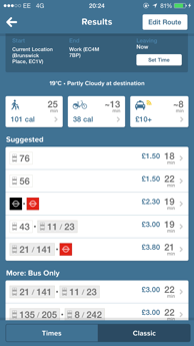
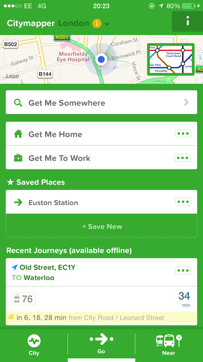
Citymapper has created a customer app where you can look real-time at transport options to get you A to B , ‘here to Work’, ‘Here to Home’ etc. via walking, cycling, car, bus, train and Tube. The app tells you how long the journey will take, when and when it leaves from, cost, changes required, and provides a route map. It even tells you when to get off the bus, and a friend when you’ll be arriving

Transport for London benefits from this by having access to rich data on the way people are travelling around London – they can improve their transport services for the capital based on these learnings.

London was the first city but Citymapper is now in 23 cities including Manchester, Paris, Hamburg, Berlin, Milan, Barcelona, Madrid, Rome, New York Chicago, Mexico, SaoPaulo, Tokyo and Singapore. The same system is now used to provide journey times and options at Heathrow into London, real-time on screens in airport arrivals

TfL are also exporting their model to other cities in UK and internationally, starting with the new City mayors in Manchester?

citymapper 2Citymapper 1

Make time for Strategic Thinking Every Day

IMG_0280

Leadership Tip of Week

adapted from HBR


If you believe that only senior executives need to think strategically, think again.

No matter what level you’re at, strategic thinking is a critical skill — one that can always be improved. To hone your capacity to see the big picture, start by making sure you have a solid understanding of the industry context and business drivers.

  • Make it a routine to explore the internal trends in your day-to-day work.
  • Pay attention to the issues that get raised repeatedly, and synthesize the common obstacles your colleagues face.
  • Be proactive about connecting with peers in your organization and in your industry to understand their observations of the marketplace, and share this information across your network.
  • Take the time to understand the unique information and perspective that your job function contributes to the company.

Thinking at this higher level will position you to be more strategic in your role.

Adapted from “4 Ways to Improve Your Strategic Thinking Skills,” by Nina Bowman